Dubai Property Market Forecast 2026: What Investors Should Expect
Dubai Real Estate in 2025: Setting the Baseline for 2026
To forecast 2026, we first need to understand where 2025 left the market. Key data points from 2025:
- Total transaction value exceeded AED 450B — another all-time record
- Off-plan transactions represented approximately 58% of total volume, reflecting sustained confidence in new development
- Average residential prices across Dubai rose approximately 12–15% year-on-year — strong but moderating from the 20%+ of 2022–2023
- Population growth of approximately 120,000 net new residents in 2025 continued to support rental demand
- Hotel occupancy above 78% for the second consecutive year, supporting short-term rental yields
- Dubai GDP growth of approximately 4.8%, outpacing global averages and providing a healthy macroeconomic backdrop
The Supply Pipeline: Will New Units Flood the Market in 2026?
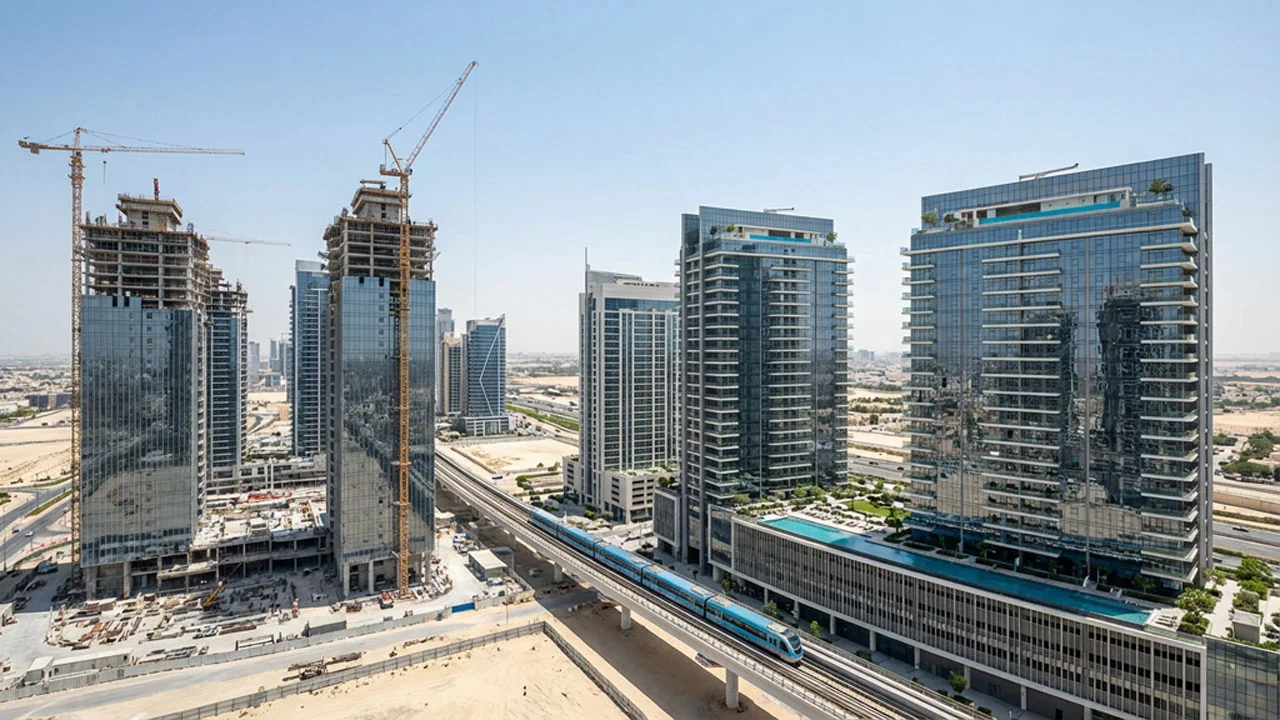
The most frequently cited risk to Dubai's price trajectory is oversupply — developers launching more units than the market can absorb. This concern is legitimate: over 50,000 units are expected to be handed over in Dubai in 2026, compared to approximately 35,000–40,000 in 2024–2025.
However, demand absorption has proven remarkably robust. Key factors that support continued demand matching supply:
- Dubai's population growth rate (consistently 4–5% per year) generates structural housing demand of 25,000–35,000 units per year independently
- The off-plan buyer pool is global — purchases from over 100 nationalities dilute the impact of any single demand source weakening
- Handover of off-plan units does not equate to increased supply reaching the rental market immediately — many buyers hold for personal use or await optimal leasing conditions
- Certain segments (ultra-luxury, beachfront, branded residences) face genuine supply scarcity regardless of overall market volume
The risk of oversupply is more pronounced in the mid-market apartment segment in outer areas (certain parts of Dubailand, Dubai South Phase 1) than in prime central and waterfront locations. Location selection in 2026 will be more important than ever.
Key Catalysts That Will Drive Dubai Property in 2026
Al Maktoum Airport Expansion Progress
The expansion of Al Maktoum International Airport into the world's largest airport is one of the biggest infrastructure stories of the decade. Construction milestones in 2026 are expected to attract significant media attention and investment activity, particularly in Dubai South and the surrounding communities. Proximity to this mega-hub will increasingly command a price premium.
Metro Blue Line Extension
Dubai's metro network expansion — including the Blue Line and extensions into Creek Harbour, Dubai Hills, and Meydan — will open access to communities that currently trade at a discount due to connectivity limitations. Areas along the new metro routes are expected to see meaningful price appreciation as opening dates approach and are confirmed.
Expo City Dubai Activation
Expo City Dubai (the legacy of Expo 2020) continues to evolve in 2026 as a tech, innovation, and community district. New residential and commercial development within Expo City adds inventory and attracts the professional and knowledge-economy residents that support Dubai's long-term growth thesis.
Continued Global HNWI Relocation
The structural flow of globally mobile wealthy individuals and families to Dubai shows no sign of reversing. In 2025, Dubai saw a net inflow of over 6,700 millionaires — the highest globally — and 2026 projections suggest this will continue, sustaining ultra-luxury and mid-luxury demand.
Price Forecast by Segment: 2026 Outlook
Based on supply-demand analysis, infrastructure catalysts, and current market momentum, here is our segment-by-segment price forecast for Dubai real estate in 2026:
- Ultra-luxury and branded residences (AED 5M+): +8–12% price growth. Supply remains scarce, global HNWI demand robust, and the flight-to-quality thesis firmly intact.
- Prime apartments — Downtown, Marina, Business Bay (AED 2M–5M): +5–8% price growth. High demand from both investors and end-users; rental yields support valuations.
- Mid-market apartments — JVC, JLT, Arjan (AED 700K–2M): +3–6% price growth. Larger supply pipeline means more competition among sellers; yields remain strong which provides support.
- Off-plan: Continued strong interest, particularly in Emaar, Nakheel, and Sobha projects. Early-phase launches will sell rapidly and should be tracked carefully.
- Villas — Dubai Hills, Arabian Ranches, Palm: +7–10% growth driven by persistent undersupply of quality family villas relative to demand.
"Dubai will not experience a correction in 2026. The demand fundamentals — population growth, HNWI inflows, zero taxes, and government-driven infrastructure spend — are simply too robust. What we will see is a more selective market where location and developer quality matter more than in the broader bull run of 2022–2024."